Is a Stacked Dado Set Worth It? Our Honest Take
Key takeaways
- Stacked dado sets promise clean, flat-bottomed grooves. We tested one across plywood and hardwood to see if it earns shelf space.
What's inside
As an Amazon Associate I earn from qualifying purchases. This post may contain affiliate links at no extra cost to you.
If you build cabinets, bookcases, or drawers, you cut a lot of dados and rabbets. A stacked dado set makes those joints fast and clean, but it is an investment, and it is one of the few blade purchases that can be flatly incompatible with the saw you already own. We tested one to see whether it’s worth it over a straight blade and multiple passes.
We judge a dado set on details you can check at the bench and confirm in scrap: how the outer blades are ground, whether the chippers sit slightly below those outers, how true the plates run, what the shim kit lets you dial in, and whether the whole stack plus washer and nut fits your arbor with threads to spare. Those criteria do not carry equal weight in every shop. A stack that leaves glass-clean shoulders in melamine is wasted money if your saw bogs halfway down the groove, and the finest shim kit made cannot rescue chippers ground taller than the blades flanking them.
As an Amazon Associate we earn from qualifying purchases at no extra cost to you. Product prices and availability are accurate as of the date shown and are subject to change.


Clean, Flat Bottoms Are the Whole Point
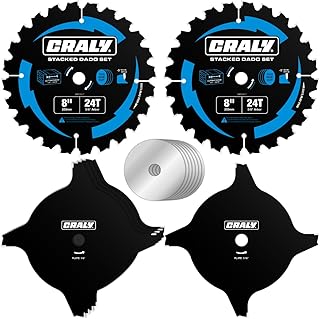
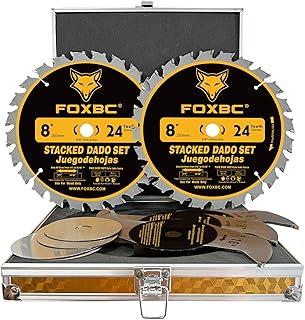
The whole point of a quality dado stack is a flat-bottomed groove with no scoring, and a good set delivers exactly that. Shims dial in the exact width to match plywood thickness, which is never quite what the label says. Sheet goods sold as three-quarter inch usually measure nearer twenty-three thirty-seconds, half-inch stock lands closer to fifteen thirty-seconds, and one sheet can drift along its own length. That gap is the difference between a shelf that seats with firm hand pressure and one you drive home with a mallet.
The stack earns that result mechanically. Two outer blades cut the shoulders with corner teeth ground square to the plate, so the walls stay crisp and the floor stays level out to the edges. Between them ride chippers, ground a few thousandths under the outers so they clear waste without leaving a ridge, and thin shims trim the total width in increments finer than a tape can read. You set it once and cut every groove in the project at that setting.
Multiple passes with a single blade is not bad woodworking, only slower and fussier. A combination or crosscut blade has an alternate top bevel grind, so its teeth come to points and leave a scalloped floor with faint scoring lines at the shoulders. A flat-top rip blade fixes the floor, but you are still moving a fence or a stop block for every pass on every part. Three passes per groove across a run of casework is where the arithmetic turns against you.
8-inch Stacked Dado Set
Flat-bottomed grooves, tight-fitting joints, and shims to match real plywood thickness. If you build casework, this pays for itself in time and joint quality within a few projects.
- ✔ Flat, clean groove bottoms
- ✔ Dial-in width with shims
- ✔ Huge time saver on casework
- ✘ Needs a saw with enough arbor
- ✘ Not for thin-kerf-only saws
What Separates a Good Set From a Bad One
Every set is a stack of compromises in steel and grinding, and these are the criteria worth inspecting, roughly in the order they show up in the joint:
- Outer blade geometry. Corner teeth must be square-ground and slightly proud so they define the shoulder. A low or negative hook angle cuts veneer and melamine with less tear-out and feels less grabby with the guard off.
- Chipper grind and diameter. Chippers should sit a whisker below the outers and be ground consistently to one another. Uneven diameters are the most common defect, and they read as ridges or a wavy floor. Four-tooth chippers run smoother than two-tooth.
- Shim kit. You want thicknesses from a few thousandths up to about a thirty-second, in a material that does not compress. Steel and brass hold their number; soft plastic deforms under arbor torque.
- Plate flatness. Runout in one plate widens the groove and roughens the walls, and the error compounds across a stack.
- Width range. Most eight-inch sets span a quarter inch to roughly thirteen sixteenths in one pass, enough for dados, rabbets, and tenon cheeks; wider grooves take two overlapping passes.
- Diameter. Eight inch is the default on a ten-inch saw, while a six-inch set trades depth you rarely need for a lighter load on the motor and less mass on the arbor.
Weigh them against your own work. Cabinet builders in veneered plywood and melamine should spend first on outer blade geometry and shim quality, because chipped face veneer is visible and permanent. Solid hardwood work rewards chipper smoothness and plate stiffness instead. If your saw is modest, fit and load outrank both.
Check Your Saw Before You Check the Price
Arbor length ends the conversation for a lot of saws. A full-width stack is thick, and it has to sit on the threaded portion of the arbor with the washer and nut fully engaged. Measure the arbor, add up the widest stack you plan to run, and confirm before you buy, because leaving the washer off or catching the nut on two threads is not a fix.
Two more compatibility checks. The stock throat plate will not clear a stack, so you need a dado insert, and a zero-clearance version also reduces tear-out at the shoulders. If your saw has an active injury-mitigation brake, it needs the dedicated dado cartridge and the blade diameter that cartridge is rated for.
Then power and technique. Removing that much material at once is a real load, so take a limited depth per pass, roughly a quarter inch at a time in hardwood, rather than the full depth in one go. The guard and riving knife come off for a non-through cut, so your usual anti-kickback hardware is gone. Cross-grain dados belong on a miter gauge or crosscut sled with a stop block, grooves with the grain want featherboards, and rabbets want a sacrificial auxiliary fence.
What You Get at Each Price Band
Entry tier. Thin carbide, two-tooth chippers, plastic shims, and grinding tolerances you can see. Expect some ridging in the floor and shoulders that need help in veneer. For utility shelving, shop fixtures, and softwood that is often enough, and it still beats three passes with a rip blade.
Middle tier. Where most shops should land. Consistently ground chippers, a usable metal shim assortment, sane hook angles on the outers, and carbide thick enough to resharpen more than once. Flat floors and clean walls without drama.
Premium tier. You are buying tighter tolerances and quieter cutting: matched chipper diameters, low-hook outers for melamine and prefinished plywood, tensioned plates, fine shim increments, and years of resharpening life. Worth it if you cut sheet goods for money. Overkill for one bookcase every other spring.
Mistakes That Ruin Good Stock
- Trusting the label. Test-cut in an offcut from the same sheet, and check the fit of the actual mating part instead of measuring the groove.
- Stacking carelessly. Spread the chippers around the circumference so their teeth land in the gullets of the outer blades, never on another tooth. Bunched teeth mean vibration and a rough floor.
- Full depth in one pass. Burning, bogging, and blade deflection all start here.
- Chasing a tight fit. A dado should close with firm hand pressure. Hammer-tight joints starve the glue line and split panels when the air dries out.
- Losing the shims. Keep them in the case; a set without shims is a set with fixed widths.
- Freehanding a cross-grain cut. With no guard and no riving knife, a sled or miter gauge is not optional.
Who Should Buy One, and Who Should Skip It
Buy one if you build casework: cabinets, built-ins, drawer boxes, shelving, anything where a dozen grooves have to match. The same stack cuts rabbets for backs, half-laps, and tenon cheeks, so it earns its keep beyond dados. It wants a full-size saw with a long enough arbor and enough motor to pull a wide cut through hardwood.
Skip it if you cut a handful of grooves a year, if your saw is a compact unit with a short arbor, or if most of your grooves are stopped, curved, or in panels too big to steer across a saw table. A router with a straightedge handles those better. If your joinery is mostly pocket screws, dowels, or loose tenons, the money belongs elsewhere.
FAQ
Will it work on a jobsite or compact table saw?
Sometimes. Check arbor length first, since many short arbors will not take a full stack with the nut properly engaged. Even when it fits, a smaller motor prefers a six-inch set, narrower settings, and shallow passes.
Do I need a special throat plate?
Yes. The stock insert will not clear a stack, and cutting into it is not an option. Use a dado insert, and make a zero-clearance version for your most-used width if you want the cleanest shoulders in veneer.
Can I cut stopped dados with it?
Not safely on a table saw. Stopped and blind grooves are router work, with a straightedge or template and a stop at the end of the cut. Use the stack for through grooves and rabbets.
Is an adjustable wobble dado a cheaper substitute?
It changes width in seconds, but a single blade on an angled hub leaves a slightly dished floor and rougher walls. Fine for utility work, not for joints you want tight and invisible in finished casework.
Verdict
If you build anything with shelves or drawers, yes — a dado stack is worth it. Confirm your saw’s arbor is long enough first. Then feed test cuts in scrap to nail the fit before you touch good stock. Works beautifully alongside our recommended contractor saw.
The middle tier is the honest recommendation for most readers, because it buys the flat floors and crisp shoulders that justify the purchase and leaves the last increment of refinement to shops cutting sheet goods every week. Budget for a dado insert at the same time, since the set does not work without one.