Best Table Saws with Precision Miter Slots for Crosscut Sleds
What's inside
As an Amazon Associate I earn from qualifying purchases. This post may contain affiliate links at no extra cost to you.
Contents
Why Miter Slot Accuracy Matters
A crosscut sled is only as accurate as the table saw that guides it. The sled rides on runners fitted into the saw’s miter slots, so a slot that is not parallel to the blade can steer the sled into a slight angle on every cut. That error may be hard to see on one cut, but it compounds when you are building picture frames, cabinet parts, or a batch of identical boxes.
For sled work, look for miter slots that are straight, parallel to the blade, and deep enough to support a runner without bottoming out. Standard slots are usually about 3/4 inch wide and 3/8 inch deep, although the actual dimensions vary. A slot can also be accurately machined but poorly aligned to the blade; both qualities matter.
The best table saws with standard miter slots have solid cast-iron or well-supported steel tables, minimal slot movement, and a fence or blade alignment system that can be adjusted independently. A lightweight saw is not automatically unsuitable, but its stamped table and loose slot tolerances may require more tuning.
What to Check Before Buying
First, check whether the slots are continuous and usable along the entire travel of the sled. Some compact saws have short, nonstandard slots or molded table surfaces that make a large sled awkward. A full-size sled commonly needs 24 to 36 inches of travel in front of the blade, so a small tabletop can limit the design even if the slots themselves are accurate.
Next, check the table flatness. A sled bridges the table and must stay stable as it moves. A shallow dip or raised edge can cause rocking, which produces a cut that is square at one point and off at another. Cast iron is usually easier to flatten and tune than thin stamped steel, though it adds weight and can rust if neglected.
Finally, inspect the relationship between the miter slots and blade. A simple test is to mark one tooth with a permanent marker, measure from that tooth to the slot at the front, rotate the blade to the rear, and measure again. Differences of roughly 0.003 to 0.005 inch are manageable for many shop projects; larger differences deserve adjustment before building a precision sled. Always follow the saw’s manual when adjusting the trunnions.
Best Table Saw Types for Crosscut Sleds
| Saw type | Slot and sled suitability | Main trade-off |
|---|---|---|
| Cabinet saw | Best overall: rigid table, long slots, stable alignment | Expensive, heavy, and usually permanent |
| Contractor-style saw | Very good if the cast-iron wings and slots are well aligned | Stand and table extensions may need tuning |
| Hybrid saw | Good precision for most home shops | Less rigid than a full cabinet saw |
| Jobsite saw | Acceptable for small, light sleds and general crosscutting | Short or nonstandard slots, lighter table, more vibration |
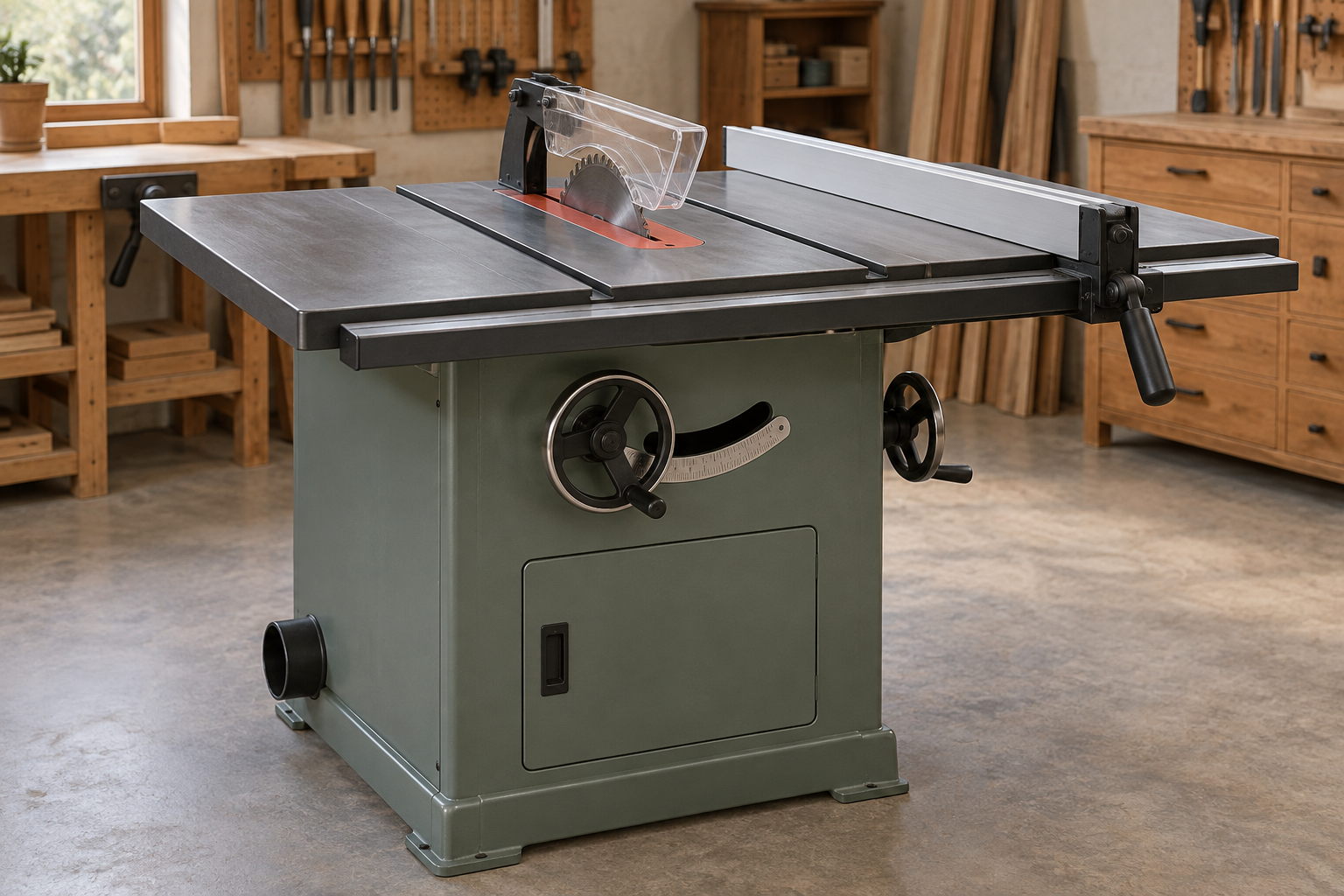
A cabinet saw is the straightforward choice for a permanent shop. Its cast-iron top does not flex under a wide sled, and the heavier base reduces vibration. You pay for that stability with floor space and difficult installation. If you routinely cut wide panels or need repeatable joinery, the extra rigidity is useful rather than cosmetic.
A hybrid or contractor-style saw is the sensible middle ground for many woodworkers. It can produce excellent sled cuts after alignment, and the lower price leaves room for a good blade and dust collection. The cheaper option is fine when your projects are small, your stock is properly supported, and you are willing to verify alignment instead of assuming it is perfect out of the box.
When a Jobsite Saw Is Enough
Do not dismiss a jobsite saw if portability matters. A well-tuned portable saw can make accurate crosscuts, especially with a compact sled or a miter gauge that fits its slots. It is a poor match for a heavy full-size sled, however. The table may flex, the stand may shift, and the saw can move when the sled is pushed through a thick board.
Many portable saws use narrow or proprietary miter slots. That does not make a sled impossible, but it may force you to mill custom runners or use low-profile runners that are difficult to replace. Before buying, download the manual or inspect the slot dimensions. Confirm that the slot is deep enough for the runner and that its walls are parallel rather than tapered.
For a portable setup, consider portable table saws with usable miter slots rather than choosing by motor power alone. A 15-amp motor does not compensate for a table that shifts under load.
Building and Tuning the Sled
Use a stable base, such as 1/2-inch or 3/4-inch plywood, and make the runner fit snugly without binding. The runner should slide freely with no side-to-side play. If it rocks in the slot, the sled can rotate slightly during a cut. UHMW plastic runners are easy to fit and resist seasonal swelling; hardwood runners can work well but need careful sizing and finish.
Fasten the runners from the underside while the sled is positioned on the saw. Use shallow screws and countersink them so they cannot touch the table. A screw that protrudes by even a fraction of an inch can scratch cast iron or lift the sled. Wax on the runners reduces drag, but it will not fix a loose fit.
After installing the rear fence, make a five-cut test. Cut one edge of a square panel, rotate the same edge against the fence for each successive cut, and compare the final offcut. If the last joint is twice as wide at one end as the other, divide that error by four and adjust the fence by that amount. This method can produce excellent results, but only if the saw’s slots and blade are already aligned.
Features Worth Paying For
Spend more for a rigid table, reliable blade-height and tilt mechanisms, accessible trunnion adjustments, and a fence that locks parallel without excessive force. A good dust port is also valuable because packed dust under the sled can change its height and cause inconsistent cuts.
A precision miter gauge is useful for angled work, but it does not replace a sled for repeatable 90-degree crosscuts. If you need both, compare table saw precision miter gauges after confirming the gauge fits your slot dimensions.
Buy the most rigid saw your shop and budget can support, but do not confuse weight with accuracy. A less expensive hybrid saw that is aligned, firmly mounted, and paired with a properly fitted sled will outperform a premium saw that is installed on an unstable floor or left out of adjustment.