How to Replace a Table Saw Drive Belt Without Losing Alignment
What's inside
As an Amazon Associate I earn from qualifying purchases. This post may contain affiliate links at no extra cost to you.
A table saw drive belt is a small part, but changing it can disturb the pulley alignment that keeps the saw quiet and efficient. A belt that is only slightly off-center can walk toward a pulley edge, squeal under load, or throw vibration into the blade. The safest approach is to treat belt replacement as an alignment job, not just a belt swap.
Contents
Before You Start
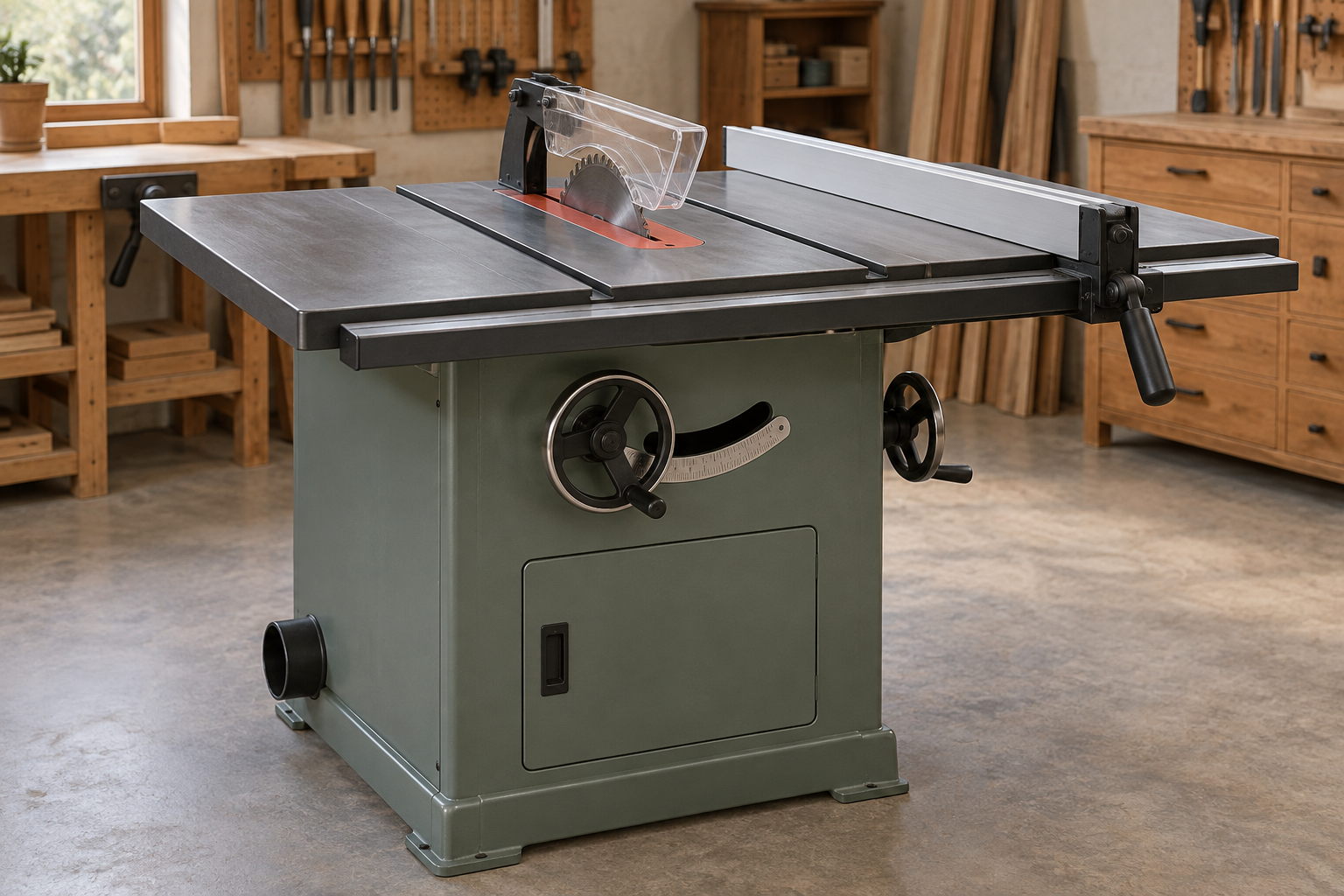
Unplug the saw and remove the blade, throat plate, and blade guard if they block access. Do not rely on the power switch. If the saw has a motor brake or electronic controls, give the machine several minutes after unplugging before working inside the cabinet.
Find the correct replacement belt before removing the old one. Measure the old belt only as a rough reference; a stretched or damaged belt may no longer represent its original length. The saw’s manual, parts diagram, or belt markings are more reliable. If you need a replacement, compare table saw replacement drive belts by length, width, construction, and profile rather than buying the first belt that looks close.
Take clear photos of the motor mount, pulley positions, and belt routing. Then use a marker or scribe to make reference marks on the motor bracket and mounting hardware. These marks will not replace alignment checks, but they make it easier to return the motor to its previous position.
Choose the Right Belt
Most contractor and cabinet saws use either a conventional V-belt or a link-style replacement belt. Some newer saws use a poly-V, serpentine, or toothed belt. The belt must match the pulley groove. A standard V-belt is not a substitute for a poly-V belt, and a belt that is too narrow will sit too deeply in the groove.
| Belt type | Advantages | Trade-offs | Best use |
|---|---|---|---|
| Standard V-belt | Inexpensive, durable, widely available | Can transmit more vibration if worn, mismatched, or misaligned | Most older contractor and cabinet saws |
| Link-style belt | Easy to install without removing a pulley; length can be adjusted | Costs more and may be noisier on some saws | Tight-access motors or saws where pulley removal is undesirable |
| Poly-V or serpentine belt | Often runs smoothly and handles compact pulley layouts | Must match the exact rib pattern and length | Saws designed specifically for that belt profile |
A link belt can be a sensible convenience purchase when the motor shaft or pulley is difficult to access. It is not automatically a performance upgrade. If the saw is properly aligned, a good conventional belt is usually the cheaper and perfectly adequate choice. Search for link belts for table saws only after confirming the required belt width and pulley profile.
Remove the Old Belt Without Moving the Motor
Rotate the belt by hand while inspecting it. Look for cracks, glazing, missing chunks, frayed edges, and a polished or uneven sidewall. Also spin both pulleys. A rough bearing, bent pulley, or loose set screw can destroy a new belt quickly.
Loosen the motor mounting bolts just enough to let the motor slide. Do not remove the bolts, and do not loosen unrelated trunnion or cabinet hardware. Push the motor toward the driven pulley to create slack. On many saws, this is enough to lift the belt off by hand while rotating the pulley. Never pry the belt off with a screwdriver; that can damage the belt, pulley edge, or motor shaft.
If the motor has a hinged mount, release the tensioning hardware according to the manual. Keep washers and spacers in their original positions. A missing spacer can change pulley alignment even if the motor returns to the same-looking location.
Install and Align the New Belt
Clean both pulley grooves with a dry rag. Do not use belt dressing, grease, or oil. Set the new belt fully into the grooves, then slide the motor away from the driven pulley until the belt is tensioned. Tighten the motor bolts lightly, but leave enough movement for final adjustment.
Use a straightedge across the faces of the two pulleys. A steel ruler, machinist’s straightedge, or even a reliably straight metal bar works better than judging by eye. The straightedge should touch both pulley faces evenly. If one pulley sits forward or backward, correct the motor position or use the original factory spacers. Do not bend a pulley or force the belt to compensate.
For a typical V-belt, press the center of the longest free span with moderate finger pressure. Many saws work acceptably with roughly 1/4 to 1/2 inch of deflection, but the manufacturer’s specification takes priority. The belt should not be guitar-string tight. Excess tension overloads motor and arbor bearings; too little tension allows slipping and heat. If the belt squeals during a cut, do not immediately tighten it—the pulleys may be misaligned or the blade may be overloaded.
Turn the belt and pulleys by hand for at least two complete revolutions. Watch whether the belt tracks in the center of both pulleys. Stop if it climbs an edge, flutters, or makes a repeating thump. Recheck pulley runout, belt seating, and alignment before powering up.
Test the Saw in Stages
With the cabinet clear and all tools removed, reinstall the blade and guards. Stand to the side of the blade, then run the saw briefly with no stock. Listen for chirping, slapping, or a rising vibration. Shut it down and unplug it before touching anything if the belt moves sideways or the motor shifts.
After a one-minute no-load test, make a light cut in scrap lumber. Check the belt again after the saw cools. A new belt may settle slightly, but it should remain centered. Check tension after the first few hours of use and again after several woodworking sessions.
Common Failure Modes
A belt that repeatedly comes off usually indicates a bent pulley, loose motor mount, bad arbor bearing, or severe misalignment—not a belt that needs more tension. Persistent vibration can also come from a warped blade, dirty arbor flange, or unbalanced pulley.
If the replacement belt is the correct length but will not seat properly, verify the profile and width. Never stack washers under a pulley as a quick alignment fix unless the saw’s original design uses them. When a pulley is damaged or its set screw will not hold, replace that part before running the saw. A new belt is inexpensive compared with a damaged motor, arbor, or workpiece.