How to Clean and Lubricate Table Saw Height Controls
What's inside
As an Amazon Associate I earn from qualifying purchases. This post may contain affiliate links at no extra cost to you.
A table saw’s height wheel should turn smoothly with one hand. If it takes both hands, skips, binds at certain points, or drops slightly after you release it, the elevation mechanism probably needs cleaning and lubrication. Sawdust mixed with grease creates an abrasive paste on the worm gear, trunnion threads, and guide surfaces. Ignoring it can wear the parts and make accurate blade-height adjustments difficult.
This procedure applies to most contractor, hybrid, and cabinet table saws with a handwheel-driven elevation mechanism. Check your saw’s manual before removing covers or using lubricant. Some manufacturers specify dry lubricant only, while others permit a light machine oil on particular pivot points.
Contents
Before You Start
Unplug the saw. Do not rely on the power switch, and do not work inside the cabinet with the saw connected to power. Lower the blade fully, remove the throat plate, and take out the blade if you need more room around the arbor and trunnions. Wear eye protection when blowing out debris.
Gather a shop vacuum, nylon brush, old toothbrush, clean rags, a plastic scraper, and a small flashlight. A short nozzle on the vacuum is safer than compressed air because it removes dust instead of driving it deeper into bearings and switches. If you use compressed air, keep the pressure moderate and wear eye protection.
Useful lubricants include dry PTFE, dry graphite, white lithium grease, and light machine oil. Do not use penetrating oil as the main lubricant. Products such as WD-40 can loosen grime temporarily, but the solvent evaporates and often leaves the mechanism under-lubricated. Avoid cooking oil, motor oil, and heavy automotive grease.
Inspect the Height Mechanism
Turn the height wheel through its full range before cleaning. Notice whether the resistance is constant or concentrated at one position. A rough spot that repeats once per revolution can indicate damaged gear teeth. Resistance that increases near the top or bottom may mean the blade assembly is contacting a stop, the trunnions are misaligned, or the elevation screw is bent.
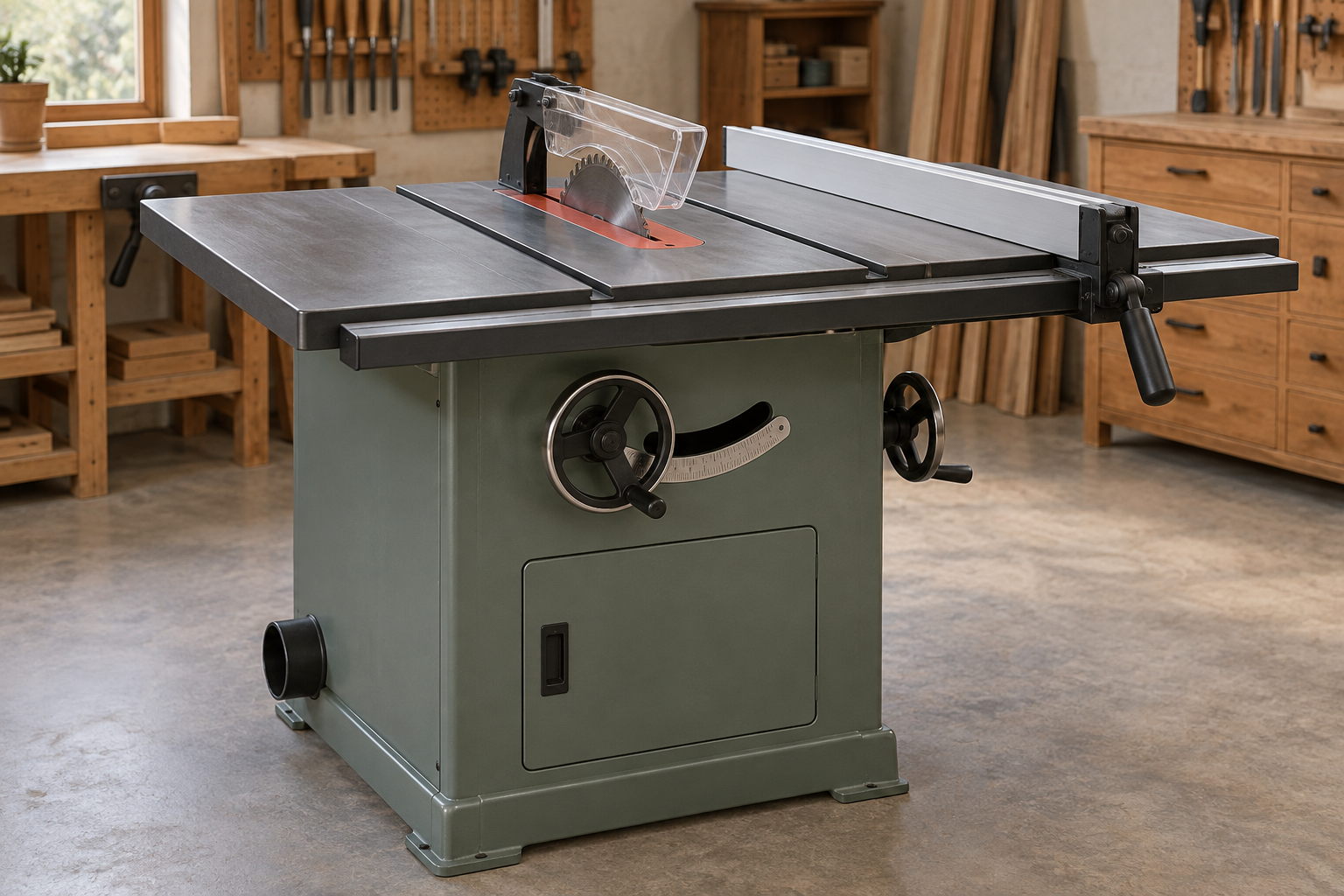
Look for the elevation worm gear, the large sector gear or toothed arc, the threaded elevation screw, and the pivot points where the trunnion assembly moves. Cabinet saws often have grease fittings or accessible pivot shafts; many contractor saws do not. Also inspect the bevel-lock mechanism. A loose bevel lock can make the assembly feel like an elevation problem when the real issue is movement in the trunnions.
If the handwheel turns freely but the blade does not rise, stop using the saw. A loose handwheel, stripped key, disconnected shaft, or damaged gear needs repair rather than more lubricant.
Clean Before Applying Lubricant
Vacuum loose sawdust from the cabinet and around the gears. Use a brush to work dust out of the gear teeth while slowly turning the handwheel. Keep your fingers clear of the teeth and moving trunnions. Scrape hardened grease from flat surfaces with a plastic scraper, not a screwdriver, which can gouge cast iron.
Wipe the elevation screw and accessible gear surfaces with a dry rag. If old grease is gummy, use a small amount of mineral spirits on the rag, keeping it away from motors, electrical parts, painted labels, and plastic components. Let cleaned parts dry completely. Do not flood the mechanism with solvent.
Cleaning is often enough to restore a stiff saw. Sawdust packed between the worm gear and sector gear can add substantial drag, and adding fresh grease over it makes the problem worse. Check the cleaned teeth for sharp burrs, chipped sections, or uneven wear before lubricating.
Choose the Right Lubricant
| Lubricant | Best use | Advantages | Drawbacks |
|---|---|---|---|
| Dry PTFE spray or powder | Exposed gears, screws, and dusty shops | Does not stay tacky; attracts less sawdust | Needs more frequent reapplication |
| White lithium grease | Clean, enclosed gears and pivot points | Long-lasting and effective under load | Collects dust if applied heavily |
| Light machine oil | Specific shafts, bushings, and pivots | Penetrates well; inexpensive | Can migrate and form a dirt-catching film |
| Penetrating oil | Loosening stuck parts only | Useful during disassembly | Not a durable elevation lubricant |
For a dusty shop, dry PTFE is usually the safest general recommendation. Compare dry PTFE lubricant products by their application tube and residue, not just the can size. A cheaper dry lubricant is fine if the nozzle lets you place a small amount accurately.
White lithium grease is a reasonable choice when the manufacturer calls for grease and the gear is enclosed. An inexpensive white lithium grease works adequately; you do not need a premium automotive formulation for a table saw’s handwheel mechanism.
Apply a Small Amount
Apply lubricant to the contact surfaces, not indiscriminately throughout the cabinet. For dry PTFE, use a light spray or dusting on the worm gear, sector gear, and elevation screw. Let the carrier flash off if the product requires it. For grease, spread a film roughly the thickness of a sheet of paper across the gear teeth with a small brush or gloved fingertip. More is not better.
Put one small drop of light machine oil on an accessible pivot shaft or bushing only when the manual permits it. Wipe away drips immediately. Keep lubricant off the arbor, blade washers, belts, motor pulley, and electrical components. Lubricant on the belt can cause slipping; lubricant on the blade or arbor flange is a safety and runout problem.
Turn the elevation wheel through its entire travel 10 to 15 times. This distributes the lubricant and exposes tight spots. Wipe away excess that squeezes out of the gear mesh. The wheel should feel smoother, but it may not become completely effortless if the blade assembly is heavy or the mechanism is worn.
Test and Maintain the Saw
Reinstall the throat plate and blade, then verify that the blade rises and lowers without contact. Check that the height scale remains accurate and that the bevel lock still holds the blade at 90 degrees. Make a test cut in scrap only after confirming the blade guard and other safety equipment are correctly installed.
Clean and lubricate the mechanism every three to six months for regular use, or sooner if the saw operates in a particularly dusty shop. Vacuuming the cabinet monthly prevents the abrasive buildup that causes most stiffness. If cleaning and lubrication do not help, or if the wheel binds at one exact point, inspect for bent shafts, worn gears, damaged threads, or misaligned trunnions. Those faults require adjustment or replacement, not additional grease.
For a lightly used saw, basic cleaning and a small can of dry lubricant are usually all you need. Spending more on specialized grease makes sense only when the manual specifies it, the mechanism carries unusually high loads, or the saw is used often enough that longer service intervals justify the cost.