The Contractor Table Saw We Keep Recommending
Key takeaways
- After a year of rip cuts, dados and sheet goods, this contractor saw is the one we hand to woodworkers building a first serious shop.
What's inside
As an Amazon Associate I earn from qualifying purchases. This post may contain affiliate links at no extra cost to you.
Most table saw buying advice stops at motor horsepower and table size, which is why so many shops end up with a machine that cuts beautifully the first Saturday and drifts out of square by the third month. A table saw is the heart of a woodworking shop, and picking the wrong one haunts you on every project. We ran this contractor saw hard for a full year — framing lumber, hardwood, and a lot of plywood — to see whether it deserves its reputation. It does, with a couple of honest caveats, and the caveats are the useful part.
We judge saws on mechanical criteria you can inspect at the bench rather than on the numbers printed on the carton: how the fence locks and whether it returns to the same place twice, where the trunnions bolt and how easily they adjust, table flatness across the wings, whether power actually reaches the arbor, and how much of the dust the saw makes ever leaves the room. Those criteria do not carry equal weight. Fence quality outranks horsepower every time. A strong motor behind a fence that creeps will hand you tapered rips for the life of the saw; a modest motor behind a fence that locks dead square only asks you to slow your feed rate in thick stock.
As an Amazon Associate we earn from qualifying purchases at no extra cost to you. Product prices and availability are accurate as of the date shown and are subject to change.


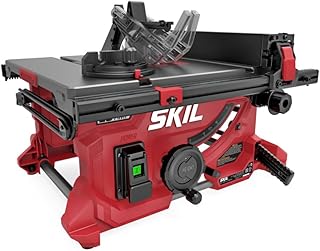
Cut Quality and Power
The motor never bogged in 8/4 maple, and the fence locks square and stays there, which is the single most important thing a table saw can do. Out of the box the miter slots were true and the blade came reasonably aligned.
Both halves of that describe a failure mode rather than a bragging point. Bogging on a well-built contractor saw is rarely a pure power problem; it is a stack of small losses — a glazed or loose belt, a dull blade or the wrong tooth count, pitch on the plate adding friction, a feed rate faster than the gullets can clear chips. When motor pitch holds steady through thick hard maple, the drive train and bearings are doing their jobs. That is also the honest ceiling for the class: it will rip dense hardwood at a sane feed rate all day, and it will never be a resaw.
The fence is what you should test in your first hour of ownership, because locking square is only half the job and repeatability is the half that matters over a year. Set a rip, cut, unlock the fence, run it to the far end of the rails, bring it back to the same setting and cut again — the two offcuts should measure the same, and the fence should read the same at the front and rear of the table. Pass that check and you can trust the scale instead of measuring every cut. When you do set alignment, remember that the miter slot is the reference, not the blade: square the blade to the slot using one marked tooth rotated front to rear, then bring the fence parallel to the slot.
Contractor Table Saw
Enough power for hardwood, a fence that actually stays square, and a footprint that fits a two-car garage. If you’re setting up a first serious shop, this is the saw we’d tell a friend to buy.
- ✔ Fence locks dead square
- ✔ Strong motor for the price
- ✔ Fits a small shop
- ✔ Accurate miter slots
- ✘ Stock blade is average
- ✘ Dust collection needs help
What Separates a Good Contractor Saw From a Bad One
The Fence and Rails
Look at how the fence clamps. Good ones pull down on the front rail and register against the rear, so tightening the lever squeezes the fence into alignment instead of twisting it out. Cheap ones grip at a single point and rely on friction; push sideways on the far end of a locked fence and you will feel it give. Rip capacity to the right of the blade matters more than overall table width — you want enough of it to put the centerline of a full sheet under the blade.
Trunnions and Adjustment
Trunnions are the castings that carry the arbor and let it rise and tilt. Budget saws bolt them to a thin top, so every adjustment fights the table and every knock to the stand can shift them. The shopping question is simpler than the engineering: can you reach the alignment bolts without pulling the top, and does the tilt run smoothly through its whole range and lock without backlash? A saw you can align in fifteen minutes stays aligned, because you will actually do it.
Table, Wings and Surface
Cast iron is not prestige, it is mass damping vibration and metal that holds flat. Lay a straightedge across the main table and both wings, corner to corner, and look for light under it. Small steps at the wing joints are adjustable; a dished or twisted main table is not. Check that the throat plate sits flush and does not rock, then plan on a zero-clearance insert anyway — it is the cheapest tearout fix you will ever build.
Power Delivery Rather Than Peak Numbers
A contractor saw is designed around the electrical service you already have, and a standard household circuit puts a hard ceiling on continuous power no matter what the box claims. That ceiling is fine for furniture-scale work. Inside it, what separates good from bad is delivery: an induction motor, a properly tensioned belt, a start that does not trip the breaker, and vibration low enough that a coin will stand on the table at full speed. The loud universal motors in the jobsite class trade smoothness and service life for portability.
Reading the Price Bands
Each step up this ladder buys specific mechanical things rather than just weight, and knowing which thing you are paying for keeps you from overspending or under-buying.
- Benchtop and jobsite saws: light tops, direct-drive universal motors, and rack-and-pinion fences that are genuinely good for the class. Right for remodelers, trim carpenters and anyone who has to carry or stand the saw up to store it. Skip this band if you want hardwood furniture, dado stacks and crosscut sleds.
- Contractor saws: cast-iron top, open stand, belt-driven induction motor, household voltage. The sweet spot for a first serious shop, and where the saw above sits. Skip it if you cut for money all day and need enclosed dust control more than a saw you can roll.
- Hybrids: an enclosed base and base-mounted trunnions in roughly a contractor footprint. You are buying easier alignment and much better dust capture, not more cutting ability.
- Cabinet saws: heavy trunnions, one big dust duct, and a motor that generally wants dedicated 240-volt wiring. Right for permanent shops and daily sheet goods. Skip it if you rent, cannot run the circuit, or need the saw in a corner every night.
Saws with active injury mitigation are a separate decision rather than a rung on this ladder. If one fits your budget, that reasonably overrides everything else here — just account for the replacement consumables before you commit.
Common Mistakes, and How to Avoid Them
- Buying horsepower and hoping the fence keeps up. Forced to choose, take the better fence and rails and feed slower.
- Referencing the fence off the blade. That bakes the blade’s own error into every rip. Everything comes off the miter slot.
- Living with the stock blade. People blame the saw for burn and tearout that a sharp, correct blade fixes immediately.
- Stripping off the riving knife and guard. The riving knife is the part that prevents kickback and it stays out of the way on through-cuts. Pull it for non-through cuts only, then put it back.
- Planning the footprint but not the path. Measure infeed and outfeed for a full sheet and your longest board, not just the space the saw occupies. A mobile base solves storage, not clearance.
What We’d Change
Swap the stock blade for a good 40-tooth combination blade on day one and hook the dust port to a real collector. Do those two things and this saw punches well above its price. For breaking down full sheets first, pair it with a track saw workflow.
The rest of the day-one list is short and cheap: a zero-clearance insert, wax on the top so stock slides instead of stalling, a full alignment check, and outfeed support so long rips do not end with the workpiece tipping. The dust caveat is structural rather than a defect — an open stand throws chips down and out, so the port alone will never catch everything. Boxing in the lower cabinet, or adding an overhead pickup, gets you the rest.
FAQ
Is a contractor saw enough for hardwood furniture?
Yes, for the scale of work most home shops do. A sharp blade matters more than the last fraction of horsepower. The real limits are thickness in a single pass and long production runs, not typical furniture stock.
Can I break down full sheets of plywood on it?
You can with the capacity and the room, but it is the least pleasant thing you will ask it to do. Wrestling a full sheet alone across an open stand is how bad cuts happen. Rough-cut sheets oversize first, then trim to final size where the fence gives you precision.
Do I need 240-volt power?
Not for this class. Contractor saws run on an ordinary household circuit, ideally one they do not share with a dust collector. Step up to 240 volts when you move into cabinet-saw territory, and price the electrical work in before you buy.
How often should I check alignment?
When the saw arrives, after you move it, and any time rips start to burn or drift. On a saw whose fence and trunnions hold, the check takes minutes and usually confirms nothing moved — which is precisely what you paid for.
Verdict
The things that are hard to fix — fence, trunnions, table, power delivery — are the things this saw gets right, and both weaknesses are bolt-on problems you solve in an afternoon. For most home woodworkers it’s more saw than you’ll outgrow for years. Highly recommended as a first “real” table saw.