A Woodworker’s Guide to Buying Your First Router
Key takeaways
- Fixed base or plunge? Which horsepower? We break down exactly what a first router needs — and what is marketing.
What's inside
As an Amazon Associate I earn from qualifying purchases. This post may contain affiliate links at no extra cost to you.
The router might be the most versatile tool in the shop — edges, joinery, templates, inlay — but the buying options are a maze. Here’s how to cut through it and buy a first router you won’t outgrow.
Most first-router advice stops at horsepower and collet size, which is why beginners so often end up with a motor too big to steer and a base that argues with every cut. The decision that shapes your first year is which base system you buy into, because that sets the ceiling on what you can attempt at all. We judge routers on what you can check with the tool in your hands: how the motor locks into the base, how finely depth adjusts and whether you can reach that adjustment from above a table, how much shank the collet really grips, how speed control holds under load, and where the switch sits once both hands are on the knobs. Peak power is the least useful number on the box.
As an Amazon Associate we earn from qualifying purchases at no extra cost to you. Product prices and availability are accurate as of the date shown and are subject to change.
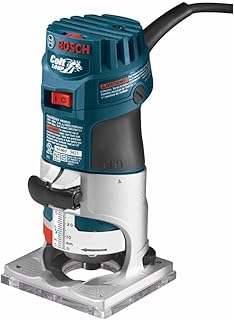


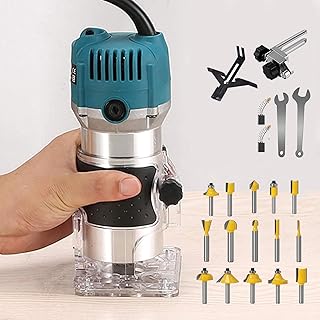

Fixed base vs plunge
A combo kit that includes both bases is the smart first buy. Use the fixed base for edge work and table mounting, the plunge base for mortises and stopped cuts. You get both jobs from one motor.
The mechanical difference is small and its consequences are not. A fixed base clamps the motor at one height and holds it there, so the cutter’s relationship to the work never shifts mid-pass. That rigidity, plus a low centre of gravity, is why it is the better base for edge profiles, flush trimming and anything hung upside down under a table. A plunge base carries the same motor on two spring-loaded posts, so you can lower a spinning bit into the middle of a panel and lift it clear at the end, stepping down through a depth-stop turret. That is the only comfortable way to cut a mortise, a stopped dado or a hinge recess.
Each base fails predictably, which is the honest argument for owning both. A fixed base cannot start a cut in the field without tipping the router in on its edge, which gets ugly with a big bit. A plunge base sits taller, pushes back at you the whole time, and is clumsy in a table. Buying one and improvising the other’s work is how beginners end up owning two routers inside a year.
When you compare kits, look hard at the handoff between motor and base. A cam lever that swaps bases without tools, a depth ring moving in countable increments, and micro-adjustment on both bases are worth more than a fraction of a horsepower. If a table is anywhere in your plans, check that the fixed base takes height adjustment from above the insert plate.
Router Combo Kit (Fixed + Plunge)
One motor, two bases, and enough power for 90% of woodworking. Variable speed lets you slow down big bits safely. The kit we recommend to every beginner.
- ✔ Two bases, one motor
- ✔ Variable speed
- ✔ Table-mountable
- ✔ Grows with your skills
- ✘ Big bits need a router table
- ✘ Learning curve on plunge cuts
The three size classes, and who each one suits
- Compact or trim routers take a 1/4 inch collet only and run one-handed. Excellent for round-overs, flush trimming, hinge mortises and small template work. Skip one as your only router if you want deep dados, larger profiles or real joinery — the collet is the ceiling.
- Mid-size routers, roughly the 1-3/4 to 2-1/4 horsepower band, accept both 1/4 and 1/2 inch shanks, work handheld and mount in a table. This is the combo-kit class and the right first buy for nearly everyone; only skip it if you already own a table router.
- Full-size routers, three horsepower and up, exist to hang in a table and spin panel-raising cutters. Too heavy to steer freehand for long, and wasted money unless a dedicated table is the plan from day one.
Specs worth paying for, in order
- A 1/2 inch collet. Thicker shanks deflect less, run cooler and leave a cleaner surface, and the better joinery bits are made in that size. It is the one spec you cannot add later.
- Variable speed with electronic feedback. Large-diameter bits must be slowed to the maker’s stated maximum, and feedback circuitry holds that lower speed under load. Soft start stops the motor twisting out of your hands.
- Depth adjustment you can trust. Fine threads, a readable scale, micro-adjust, and a setting that stays put after heavy passes. Repeatability beats travel range.
- A flat subbase, concentric to the collet. It decides how truly guide bushings and edge guides track, and whether accessories bolt on without adapters.
- Switch placement, spindle lock and dust ports on both bases. Reaching the switch without letting go, changing bits with one wrench, pulling chips away from the cut — comfort items you feel every session.
Weigh them in that order. When the budget squeezes, give up the LED, the cordless convenience and the bundled bit set long before the 1/2 inch collet or the speed dial. A corded router with mediocre dust pickup still does fine work; a single-collet router with a vague depth mechanism boxes you in by your third project.
What each price band buys
At the bottom of the market the compromise is rarely the motor — it is everything that controls the motor. Look for sloppy depth threads that drift under vibration, bases that flex when you lean on a cut, a speed dial with no feedback so rpm sags in a deep profile, and a collet that grips only a short band of shank. A cheap kit that adjusts precisely is a bargain; a cheap kit that will not hold a setting is a trap.
The middle band is where combo kits live and where the value is. You are paying for machined castings, a collet that holds and releases cleanly, speed control that does not wander, and true micro-adjustment. Judge candidates on details: how the motor drops into each base, whether above-table adjustment is included or extra, and whether collets, bushing plates and brushes are actually available.
At the top you buy refinement rather than new capability — smoother plunge action, finer adjusters, better dust shrouding, longer-lived switches. Worth it if you route weekly or your work is joinery-heavy. A beginner will not out-cut a mid-band kit with it, because at that stage bit quality and technique are the limits.
Common first-router mistakes
- Taking full depth in one pass. Several shallow passes cut cleaner, burn less and load the bit far less. It is the cheapest quality upgrade available.
- Feeding the wrong way. The bit’s rotation should pull the router against the work, not run away along it: outside edges counter-clockwise, inside openings clockwise.
- Buying the giant boxed bit set. Five good carbide bits — straight, flush trim, round-over, chamfer, rabbet — outwork thirty soft ones for similar money.
- Seating bits carelessly. Bury most of the shank, keep the collet clear of the fillet where shank meets cutter, and never clamp near the tip.
- Routing without dust control or hearing protection. A router throws more chips per minute than anything else on the bench, and it is among the loudest tools you own.
What to ignore
Don’t get pulled into buying the highest-horsepower monster first — it’s overkill and harder to control for a beginner. A mid-power variable-speed combo does everything you need while you learn. Add a router table later once your work asks for it.
Ignore peak horsepower claims across the board; amps and the way a tool holds speed under load tell you more. Ignore accessory counts. Ignore the idea that cordless is automatically an upgrade — batteries suit a trim router you pick up for two minutes, not long table sessions. Bushings, an edge guide and a table can all follow the work; a good motor and two solid bases cannot be retrofitted.
FAQ
Do I need a router table straight away?
No. Start handheld — edge profiles, flush trimming, template work and mortises all happen with the router in your hands. A table earns its place when you need repeatable joinery, want to run small stock safely, or reach for bits too large to steer freehand.
Can a trim router be my only router?
It can if your work stays small: edge treatments, hinge mortises, inlay, laminate. The moment you want deep dados or sizeable joinery cutters, the 1/4 inch collet is the ceiling. Many woodworkers end up with a mid-size combo kit plus a trim router, in that order.
Corded or cordless?
Corded for a first do-everything router: constant power for long runs and heavy passes, with no fuel gauge to watch. Cordless makes sense as a second, compact router for site work and quick jobs where the cord is the bigger annoyance.
How much power is actually enough?
A mid-size variable-speed motor covers the overwhelming majority of woodworking: dados, mortises, round-overs, flush trimming, most joinery cutters. Large panel-raising and door bits are the exception, and they belong in a table with the speed dialled down rather than in a beginner’s hands.