Benchtop Planer Showdown: Which One Actually Leaves a Clean Surface
Key takeaways
- We put three popular benchtop planers head to head on figured hardwood. Snipe, finish quality and knife changes decided it.
What's inside
As an Amazon Associate I earn from qualifying purchases. This post may contain affiliate links at no extra cost to you.
Every benchtop planer claims a glass-smooth finish. On straight-grained pine, they all deliver. The real test is figured hardwood, where tear-out and snipe separate a good planer from a frustrating one. We ran three through curly maple to find out.
Spec sheets are close to useless in this category. Nearly every 120-volt benchtop planer draws whatever a standard household circuit will give it, and cutting width clusters tightly in the 12- to 13-inch class, so the numbers on the box converge while the machines themselves do not. What varies is mechanical: whether the cutter head clamps to its posts, how many knives sit in the head, how hard the feed rollers grip, whether the extension tables can be brought into the same plane as the bed, and how repeatably the depth crank returns to a setting you already used.
As an Amazon Associate we earn from qualifying purchases at no extra cost to you. Product prices and availability are accurate as of the date shown and are subject to change.


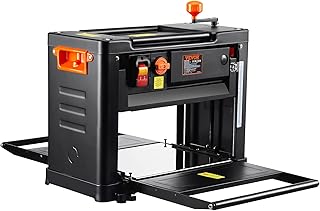


Those things you can inspect at the bench with the machine unplugged, and they are the ones that decide whether curly maple leaves the outfeed table looking finished or looking chewed. None of the three machines won everything. Each failed in a predictable way, and choosing well is mostly about picking the failure you can live with.
The criteria that actually matter
Weigh these in the order that matches your lumber, not in the order the marketing copy presents them.
- Cutter-head lock. A cam or wedge that clamps the head to its columns so it cannot rise as a board enters. This is the single biggest lever on snipe, and it is either present or it isn’t.
- Knife count and knife type. Three indexed knives put 50 percent more cuts per inch on the surface than two at the same feed rate. Disposable double-edged knives that drop onto locating pins beat knives you have to set by hand.
- Bed and extension tables. Cast, stiff, and adjustable. Stamped wings that flex under a board’s weight, or that cannot be brought coplanar with the bed, will produce snipe no matter what the head does.
- Feed rate. A second, slower speed is a genuine finish feature — same knives, more cuts per inch, less tear-out on figured stock.
- Depth adjustment. A fine-pitch crank with minimal backlash and a scale you can trust, ideally with a return-to-thickness stop for matching parts later.
- Chip extraction. A planer makes more waste per minute than anything else in a small shop. A proper hood and a 4-inch port are not optional extras.
If your work is figured hardwood, rank the head lock, knife count and feed rate first and treat everything else as convenience. If you mostly dimension construction lumber or reclaimed softwood, feed-roller grip and chip handling move up and surface refinement moves down. Bed rigidity matters in both cases, because it is the one thing you cannot fix with technique.
The snipe test
Snipe — that dip at the start and end of a board — is the number one complaint with benchtop planers. Two of our three had a lockable cutter head that nearly eliminated it. The third needed infeed support tricks to manage.
The mechanism is simple. While a board is under both feed rollers, it is held down hard against the bed. In the moment when only one roller has it, the board is free to tip and the head is free to lift on its posts by however much slop the columns allow. Whichever moves, the knives take a deeper bite and you get a dip an inch or two long at each end.
You diagnose it by feel, not by eye: drag a fingertip along the last few inches of the board, then hold the face into raking light from a window or work lamp. Snipe shows up as a shadow line where a shallow dip catches the light differently from the rest of the face.
The tricks that made the unlocked machine usable are worth knowing regardless. Set the extension tables a hair high rather than dead level so the board is always tipped into the head. Support long stock with a roller stand at the same height. Feed boards nose to tail so each one supports the next through the transition. Lift very slightly on the trailing end as it leaves the infeed. And when it matters, plane your stock a few inches long and cut the sniped ends off — the oldest fix in the book, and still the most reliable.
Benchtop Thickness Planer
The cutter-head lock made snipe a non-issue, and the three-knife setup left the cleanest surface on figured maple. Knife changes are quick. This is the one we reach for.
Tear-out and the figured-grain problem
Snipe is a geometry problem. Tear-out is a cutting problem, and figured wood is where it surfaces. In curly or quilted grain, fiber direction reverses every fraction of an inch, so some of the fibers are always being lifted rather than severed. A straight-knife head cannot avoid that entirely; it can only make each bite smaller.
Three things shrink the bite. More knives at the same feed rate means more, shallower cuts per inch. A slower feed rate does the same thing without changing the head. And a lighter depth of cut keeps the knife from reaching down into a reversing grain pocket in the first place — near final thickness, whisper passes are worth the extra trips through the machine.
Sharpness outranks all of it. Dull knives stop slicing and start crushing and lifting, and the first symptom is fuzzy, torn patches in exactly the figure you bought the board for. If your planer suddenly gets worse on maple, rotate or replace the knives before you blame the machine.
Here is how the three compared on the criteria that drove those results.
| Model | Snipe | Knives | Rating | Buy |
|---|---|---|---|---|
| Our pick | Minimal | 3 | 4.7 | See current price |
| Budget option | Moderate | 2 | 4.4 | See current price |
What you get at each price band
The entry band buys you a two-knife head, a single feed speed, stamped extension wings and usually no head lock. On pine, poplar and construction lumber, that machine is honestly fine. A bad one at this level gives itself away when you rock the cutter head by hand and feel play in the columns, or when the extension wings cannot be adjusted into plane at all.
The middle band is where the head lock, the third knife and cast extension tables appear, sometimes with a second feed speed and a depth stop worth using. This is the meaningful jump for anyone planing hardwood, and it is where our pick sits. A bad middle-band machine is one that adds a knife but keeps the flexy base — check that the tables are castings and that the depth crank has little backlash.
Above that you are paying for mass, better chip hoods, more repeatable depth setting, and either a spiral carbide head or an easy upgrade path to one. Worth knowing before you go shopping: a cheap machine plus an aftermarket helical head often costs as much as a better base machine, and you still have the lighter castings underneath.
Mistakes that make a good planer look bad
- Expecting it to flatten a board. A thickness planer makes the second face parallel to the first. Feed in a cupped or twisted board and you get a thinner cupped, twisted board. Joint one face first, or shim the board on a planer sled.
- Hogging material. Deep passes cause tear-out, bog the motor and load the rollers. Take most of the thickness in moderate passes and the last bit in very light ones.
- Neglecting the bed. A clean, waxed bed feeds smoothly. A resinous, rusty one stalls boards mid-pass and leaves stutter marks.
- Running without extraction. Chips that recirculate get pressed between the roller and the board and emboss dents into a surface you just cut clean.
- Planing reclaimed lumber blind. A hidden nail, embedded grit or old paint nicks a knife, and that nick then draws a ridge down every board you run afterward.
- Ignoring minimum length. Short offcuts can tip between the rollers or kick. Plane long and cut to length after.
Who each option suits
Buy the three-knife, locking-head machine if you work figured hardwood, resaw your own stock, or build furniture and instruments where the planed surface is close to the finished surface. The time you stop spending on scraping and sanding pays for the upgrade quickly.
The budget option suits shop projects, painted work, framing and softwood — anywhere a light sanding is part of the plan anyway, and where snipe lands in an offcut rather than in a visible part.
Skip a benchtop planer entirely if your panels are consistently wider than the 12- to 13-inch class, if you have no way to handle the chip volume or the noise, or if you only dimension a handful of boards a year. Buying lumber surfaced, or reaching for a hand plane, is cheaper than owning the wrong machine.
Which should you buy?
If you plane a lot of hardwood, pay for the cutter-head lock and three-knife design — the finish quality is worth it. For occasional softwood work, the budget model is fine. Either way, feed boards with slight overlap and support long stock to keep snipe down.
Whichever you land on, spend an hour on setup before you judge it: bring the extension tables into plane, wax the bed, confirm the knives are seated and sharp, and hook up real dust collection. Most planers described as disappointing online are simply planers nobody set up.
Pair a good planer with a reliable table saw and you can mill rough lumber to finished stock all day.
FAQ
Can a benchtop planer flatten a cupped or twisted board?
No. It references off the face riding the bed and cuts the opposite face parallel to it, so distortion survives the pass. Flatten one face first with a jointer, a hand plane or a router sled, or immobilize the board on a shimmed planer sled and let the planer cut the high spots.
Is a two-knife planer good enough?
For softwood and painted work, yes. On figured hardwood you will see the difference in cuts per inch as slightly more washboard and more torn patches, which means more sanding. Slowing your feed, if the machine offers a second speed, closes part of the gap.
Is a spiral carbide head upgrade worth it?
It helps most on figured and abrasive stock, and it runs noticeably quieter, with individual inserts you rotate instead of replacing full knives. Price the upgrade against the next machine up before committing — on an entry-band planer with a flexy base, the money is usually better spent on the base machine.
How do I eliminate snipe completely?
Lock the head, set the extension tables slightly high and coplanar, support long stock at bed height, feed boards end to end so each supports the next, and take light final passes. Even then, plan on planing a few inches long and trimming the ends when the surface has to be perfect.